

How to Choose the Right PWC Lift
Unlike full-sized boat lifts, most PWC lift models are designed to accommodate virtually any size of personal watercraft on the market today. Because weight and width are rarely an issue, your choice comes down to two main factors: Water Depth and Wave Action.
How to Choose
| Environment | Recommended Lift | Why? |
|---|---|---|
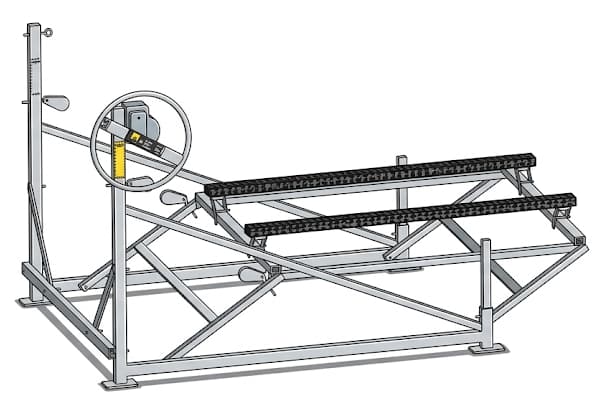
| Shallow Water / Quiet Bay | Cantilever | Economical and effective. It works in very shallow water where other lifts might bottom out. |
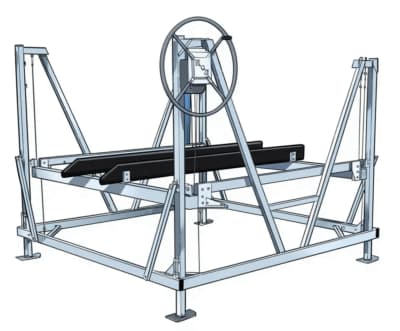
| Rough Water / High Traffic | Vertical | The safest choice for windy shorelines or busy channels. It lifts the PWC high enough that waves pass safely underneath. |
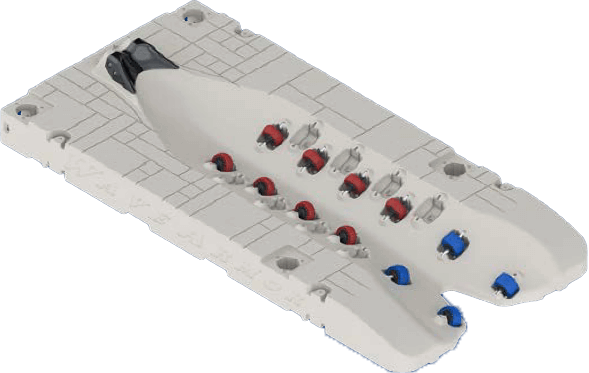
| Deep Water / Soft Bottom | Floating Port | If your lakebed drops off quickly or is too mucky to support legs, a floating port provides a stable, “drive-on” solution. |
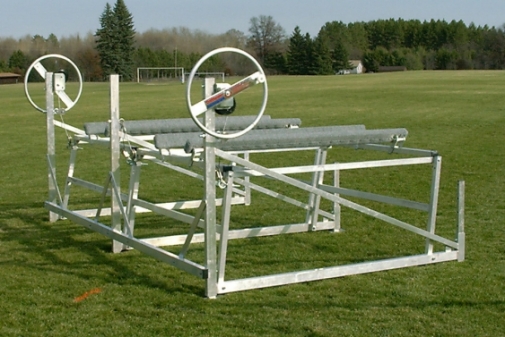
1. Cantilever PWC Lifts (The Economical Choice)
The most common solution for standard shoreline conditions. These lifts use a simple pivoting motion to raise your PWC.
- Best For: Shallow water locations with moderate wave action.
- Operation: Manual “turn-style” wheel. “Turn-Key” electric motors are available for those who want to skip the manual cranking.
2. Vertical PWC Lifts (The Rough Water Specialist)
Engineered for maximum height and stability. By lifting the PWC straight up, this design provides the most clearance between your machine and the water.
- Best For: High-energy wave zones, busy wake areas, or deeper water.
- The Advantage: Offers peace of mind during storms or high-traffic weekends.
3. Floating PWC Ports (The Deep Water Solution)
When the lakebed is too deep for legs or too soft to provide a solid foundation, a floating port is the ultimate “grab and go” solution.
- Best For: Deep water, mucky bottoms, and high-frequency use.
- The Experience: Simply throttle on to park and push off to launch. Our ports feature soft, non-marking rollers that protect your hull and make docking effortless.
The “On The Water” Advantage
Frequently Asked Questions
The right PWC lift depends largely on water depth, lakebed conditions, and wave exposure. Cantilever lifts are often used in shallow water, vertical lifts suit rougher conditions, and floating ports work well in deep or soft-bottom environments.
A traditional PWC lift mechanically raises the watercraft above the water, while a floating PWC port is a drive-on platform that supports the craft at dock level. Both protect the hull, but each suits different shoreline conditions.
Yes. Many PWC lifts are designed to accommodate a wide range of machines, with adjustable bunks, guides, or rollers that help support different hull styles and weight distributions.
Floating systems are often chosen where water is too deep for lift legs, where lakebeds are soft or mucky, or where floating docks move with changing water levels. They provide a stable alternative to standing lifts.
Yes. Keeping a personal watercraft out of the water can reduce hull staining, algae buildup, and prolonged water exposure, while also helping protect the machine from wave action and seasonal wear.